Drywallers.io / PRACTICAL GUIDE
Drywall Repair vs Replacing the Board: An Ottawa Homeowner Guide
Patch drywall when damage is small, dry and surface-level; replace the board when it's soaked by dirty water, mouldy under paint, sagging or crumbling.
 Drywallers.io
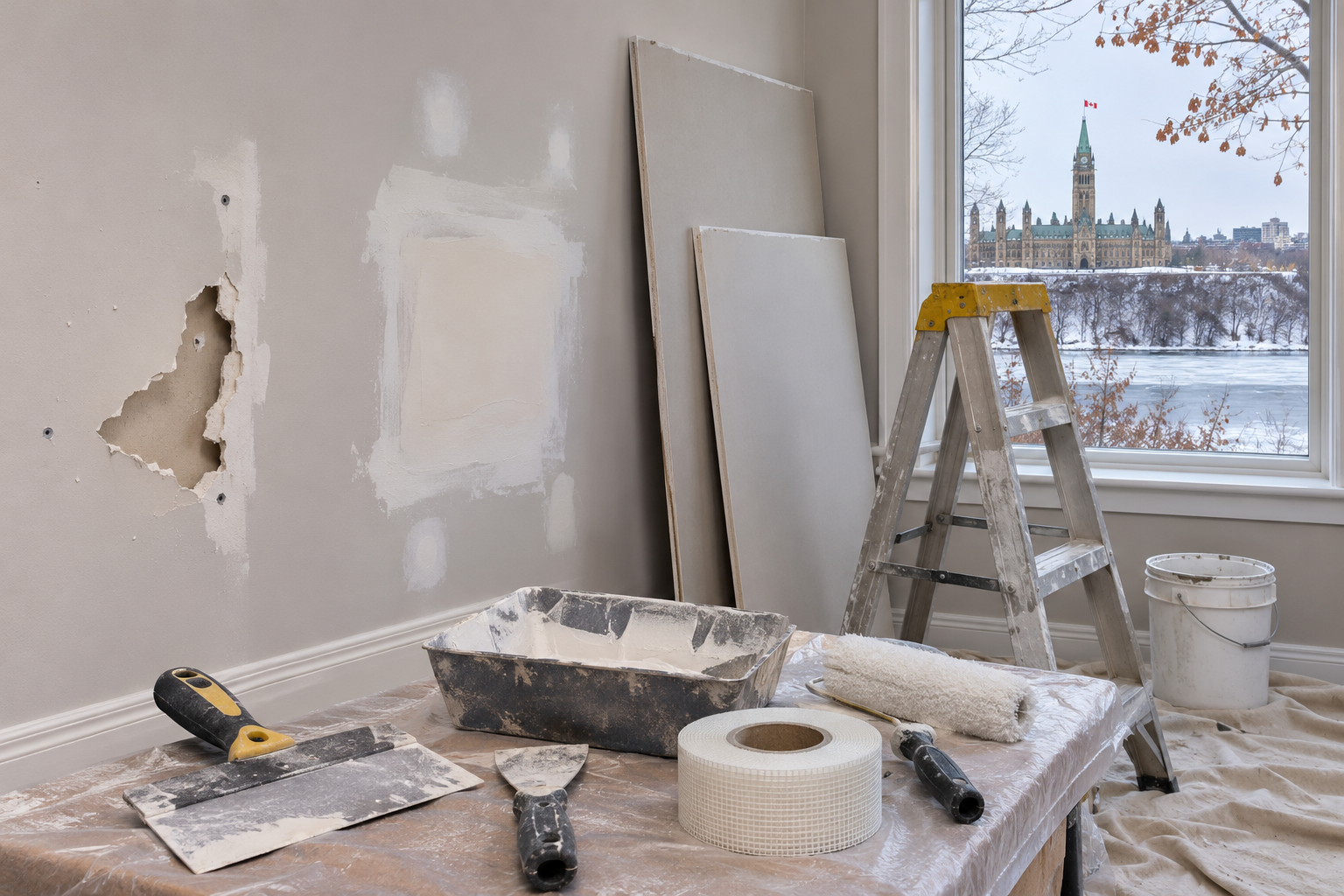
Repair the drywall when the damage is small, dry and on the surface: dents, nail pops, cracks, holes up to a few inches, or a clean-water stain on board that is still firm. Replace the board when it was soaked by dirty water, has mould under the paint, sags, crumbles or covers a large area.
That rule covers most Ottawa homes most of the time. The rest of this guide explains how to tell which side of the line your wall is on, what changes the answer in an Ottawa winter, and when the safest first step isn't a putty knife at all but a phone call to have old materials tested.
The quick decision: repair or replace?
Start with three questions. Is the board still firm? Is it dry? Is the damage only on the surface? If all three answers are yes, a repair is usually the right call. If any answer is no, look harder before you patch.
| What you see | Usually repair | Usually replace | Why |
|---|---|---|---|
| Nail or screw pops | Yes | No | Reset or add a fastener, then fill and finish |
| Hairline cracks at joints or corners | Yes | No | Re-tape and refinish the joint |
| Hole under about 15 cm (6 in.) | Yes | No | A patch or backing piece holds well |
| Hole larger than a sheet's stud bay | Sometimes | Often | A new piece fastened to framing is stronger |
| Clean-water stain, board firm and dried quickly | Yes, after drying | No | Board can often be saved if dried before mould forms |
| Board soft, swollen, sagging or crumbling | No | Yes | Gypsum core and paper have lost strength |
| Sewage or flood water exposure | No | Yes | Industry guidance says it must be replaced |
| Mould under the paint | No | Yes | Health Canada says the drywall needs to be removed |
| Fire-rated wall (e.g. garage to house) damaged | Only to original design | Often | Repair has to restore the rated assembly |
The table is a starting point, not a diagnosis. A drywall contractor can confirm in a few minutes what a photo can't show, such as whether the framing behind the board is wet.
What "repairable" damage looks like
Most of the drywall problems in a typical Ottawa house are cosmetic, and they're good candidates for repair.
Nail pops and screw pops
Small round bumps or cracked circles over fasteners are common in newer homes as framing lumber dries and shifts. The fix is to drive a new screw just beside the old fastener, set or remove the old one, and refinish. Replacing the sheet would be overkill.
Cracks at seams and corners
Cracks along taped joints or at the corners of doors and windows usually come from movement. Ottawa's swing from humid summers to very dry heated air in winter is one plausible contributor, in our view, though cracks have many causes. If a crack keeps coming back in the same place after a proper re-tape, that's a sign to look for a structural or moisture cause.
Holes and dents
Doorknob holes, furniture dents and anchor holes from old shelves are routine repairs. Small holes take mesh or a backing patch. Larger ones get a new piece of drywall screwed to backing or to the studs.
When the board itself has to go
Some damage changes the board's structure, and no amount of compound will fix that.
Water damage
Winter in Ottawa brings its own leak sources: frozen and burst pipes, ice damming at the eaves, and condensation around poorly insulated exterior walls. The key question is what kind of water it was and how fast the board dried.
The Gypsum Association's manufacturer-hosted GA-231-2019 guidance describes assessment after drying and distinguishes contaminated exposure from potentially salvageable material. It is an older technical reference, not an Ottawa permit rule; the Association now lists a 2025 edition. Do not infer that a clean-water stain proves the board is suitable to retain. Assess exposure, condition and drying together.
Health Canada's guide on moisture and mould makes the same timing point from the health side: mould will begin to grow in an area with excessive moisture within 48 hours.
In practice, if a burst pipe soaked a wall on Friday and it was still damp on Monday, plan on cutting out the wet section and checking the insulation and framing behind it.
Mould
Health Canada's guide sorts mould by size. Three or fewer patches totalling less than 1 square metre is a small area that can be cleaned with precautions. More than three patches, or patches between 1 and 3 square metres, is medium: expert assessment is recommended, though in most cases you can clean it yourself with care. A single patch larger than 3 square metres needs expert assessment and cleanup.
The deciding detail for drywall is where the mould sits. Health Canada says that if the mould is underneath the paint, the drywall will need to be removed and replaced. Painting over mould only hides it for a while.
Sagging ceilings and crumbling board
A ceiling that dips between joists, or board that crumbles when pressed, has lost its strength. That's a replacement job, and a sagging ceiling should be treated as a safety issue until someone looks at it.
Check for asbestos before you cut in an older home
Much of Ottawa's housing stock, from Glebe and Westboro brick homes to postwar bungalows in Alta Vista, was built well before 1990. Health Canada says asbestos was used in a variety of building materials in some homes built before 1990, naming plaster and tiles among them, and advises having your home tested by a professional before you start renovating. It also warns never to disturb or try to remove asbestos yourself.
For drywall work, that means: in a pre-1990 home, don't sand old joint compound, cut out a section or open a plaster wall until the material has been tested. A test costs far less than cleaning up a contaminated room.
Do you need a permit in Ottawa?
Ottawa's current building-repairs FAQ explicitly lists removal of drywall or other interior finish among repairs not requiring a building permit. It separately identifies structural damage and structural framing repairs as permit work. This limited repair guidance does not settle every alteration, shared separation or change of use. Describe the full proposed scope to Building Code Services before treating a larger renovation as a cosmetic repair. The City provides buildingpermits@ottawa.ca and 3-1-1 for questions.
If cutting open a wall shows rot or damage in the studs, a framing contractor should assess it before new board goes up. Our sister site framers.io explains how framing repairs fit into renovations.
Fire-rated walls need special care
The wall and ceiling between an attached garage and the house, and walls between units in some townhomes and multiplexes, are often built as fire-rated or sound-rated assemblies. The Gypsum Association's guidance says repairs to these assemblies should be consistent with the original design, including board type, fasteners, fastener spacing and staggered joints.
So a patch with regular board on a fire-rated garage wall isn't a like-for-like repair. If you're not sure whether a wall is rated, ask before you patch.
Repair vs replace: cost and time
Ottawa-specific pricing data for drywall repair isn't publicly available, so we won't quote numbers. What we can say is how the jobs usually compare:
- Repairs are mostly labour and drying time. A small patch still needs several coats of compound, each dried, then sanding, primer and paint. Even a minor repair often spans more than one visit.
- Replacement adds material, disposal and sometimes insulation or vapour barrier work behind the board, plus finishing that may extend to a whole wall so the paint matches.
- Winter drying is slower in cold, unheated spaces. Keep the room heated and ventilated while compound and paint cure.
Get the price and scope in writing, including payment stages, disposal, finishes, exclusions and a written change process. Ontario publishes consumer guidance on renovation contracts and estimates. Check the current provincial guidance for the contract and sales circumstances rather than assuming every agreement has identical cancellation terms. A clear signed scope is useful even when a particular legal threshold does not apply.
Checklist before you decide
- [ ] Find and stop the water source if there's any staining
- [ ] Press the board: firm, or soft and crumbly?
- [ ] Note what kind of water it was: clean supply line, rain, or sewage and flood water
- [ ] Note how long the area stayed wet
- [ ] Look for mould on the surface and ask whether it may be under the paint
- [ ] Check the home's age; test materials first if it was built before 1990
- [ ] Ask whether the wall is fire-rated (garage walls, shared walls)
- [ ] Confirm whether the job has grown into permit territory
- [ ] Get a written quote that states repair or replacement and the finish level
Common mistakes Ottawa homeowners make
Patching over a wet wall. Compound over damp board traps moisture and invites mould. Dry first, then decide.
Painting over mould. It returns, and it may be worse behind the paint.
Sanding old walls without testing. In a pre-1990 home, test first.
Fixing the stain but not the leak. An ice dam or slow drip will undo the repair by spring.
Using regular board on a rated wall. It looks fine and fails the job it was built for.
Questions to ask before anyone starts
A good contractor will welcome these questions, and the answers tell you a lot about how the job will go.
- Will you repair or replace, and why? Ask them to point to what they saw: soft board, staining, mould, the size of the hole.
- Where is the water coming from, and is it fixed? A drywall crew can't fix a roof or a plumbing leak, but they should refuse to close a wall over an active one.
- What's behind the board? If they're cutting out a section anyway, ask them to look at the insulation, vapour barrier and studs and tell you what they find.
- How many visits will it take? Compound has to dry between coats. Two or three visits for a modest repair is normal.
- What finish level and paint are included? A patch that's primed but not painted will still look like a patch.
- How will you control dust? In winter, with windows shut, plastic sheeting and a vacuum on the sander make a real difference.
- Has the material been tested? In a pre-1990 home, ask whether testing is needed before they cut.
Write the answers into the quote. If something changes once the wall is open, Ontario's rules expect a signed change to the contract rather than a surprise on the final bill.
Key Data Points
- Mould can begin to grow in an area with excess moisture within 48 hours (Health Canada).
- A small mould area is three or fewer patches totalling less than 1 m²; a single patch over 3 m² needs expert cleanup (Health Canada).
- Water exposure requires assessment of contamination, drying and material condition; older Gypsum Association guidance is a technical reference, not a guarantee that a particular wall can be retained.
- Asbestos was used in some building materials in homes built before 1990 (Health Canada).
- Ottawa-specific drywall repair pricing is not publicly available.
The bottom line
Most drywall damage in Ottawa homes is repairable, and a good repair is invisible. The board needs replacing when water, mould or time has damaged its core, when the water was dirty, or when the wall has a fire rating to restore. Dry first, test old materials, and get the decision and the price in writing before anyone starts cutting.
Compare two Ottawa repair scopes before choosing a contractor
Consider two hypothetical jobs rather than assuming every damaged wall needs the same treatment. The first is a dry doorknob hole in an ordinary interior partition. There is no staining or repeated movement, the surrounding material is sound, and the surface is not part of a special assembly. The quote can focus on a supported patch, finishing, dust protection and an agreed paint boundary. A whole-room replacement proposal should explain what additional defect makes that necessary.
The second is a stained basement wall with a musty smell and an uncertain leak history. Its first quote should not promise an invisible patch on a fixed date. It needs a moisture investigation, appropriate material checks and a method for documenting concealed findings. Only then can the owner sensibly compare retention with replacement. Location in Ottawa does not establish the water source or the wall's construction.
For either job, ask bidders to name what they have inspected and what remains unknown. Ask whether insulation, trim, paint, hazardous-material work and disposal are included. Identify who authorizes changes and how photographs or inspection findings will support them. This creates a usable decision record and reduces the chance of comparing a full restoration price with a surface-only repair.
Frequently asked questions
When should drywall be replaced instead of repaired?
Replacement is appropriate when contamination or damage makes retention unsuitable, including soft, sagging or deteriorated material and mould beneath paint or paper. The moisture source and concealed assembly need assessment before closure.
Does removing damaged drywall require an Ottawa permit?
Ottawa lists removal of drywall or other interior finish among repairs not requiring a permit, while structural damage and structural framing repairs require one. Ask Building Code Services about the complete scope if the work changes walls, services or a required separation.
Can a small hole be repaired without replacing a whole sheet?
Often yes when the surrounding board is sound and the patch can be supported appropriately. The contractor should check for concealed services and special assembly requirements before disturbing the wall.
Should older joint compound be tested before sanding?
Have suspect older materials professionally assessed before disturbing them. Appearance alone cannot rule out asbestos, and a pre-1990 construction date is an important warning rather than a universal test result.
Sources and further reading
- Health Canada: Guide to addressing moisture and mould indoors
- Health Canada: Planning a renovation? Asbestos, what you need to know
- City of Ottawa: Do I need a building permit?
- Government of Ontario: Your rights when starting home renovations or repairs
- Government of Ontario: A guide for home renovation and roofing businesses
- City of Ottawa: building repairs and protection FAQ
- Gypsum Association GA-231-2019: historical assessment guidance hosted by American Gypsum
- Gypsum Association: current GA-231-2025 edition listing